Set up Kula Intelligence.
Connect the systems you run and share the documents you have. Kula builds a model of how your business works, and keeps learning, week by week.
Kula helps your team know what needs doing and see it through. Requests, shift cover, faults, follow-ups and handovers, all managed from their phones, under your rules. What your team learns stays with the business.
Start with the systems you already use. See it working before changing how you work.
Your people run the business. Kula backs them.

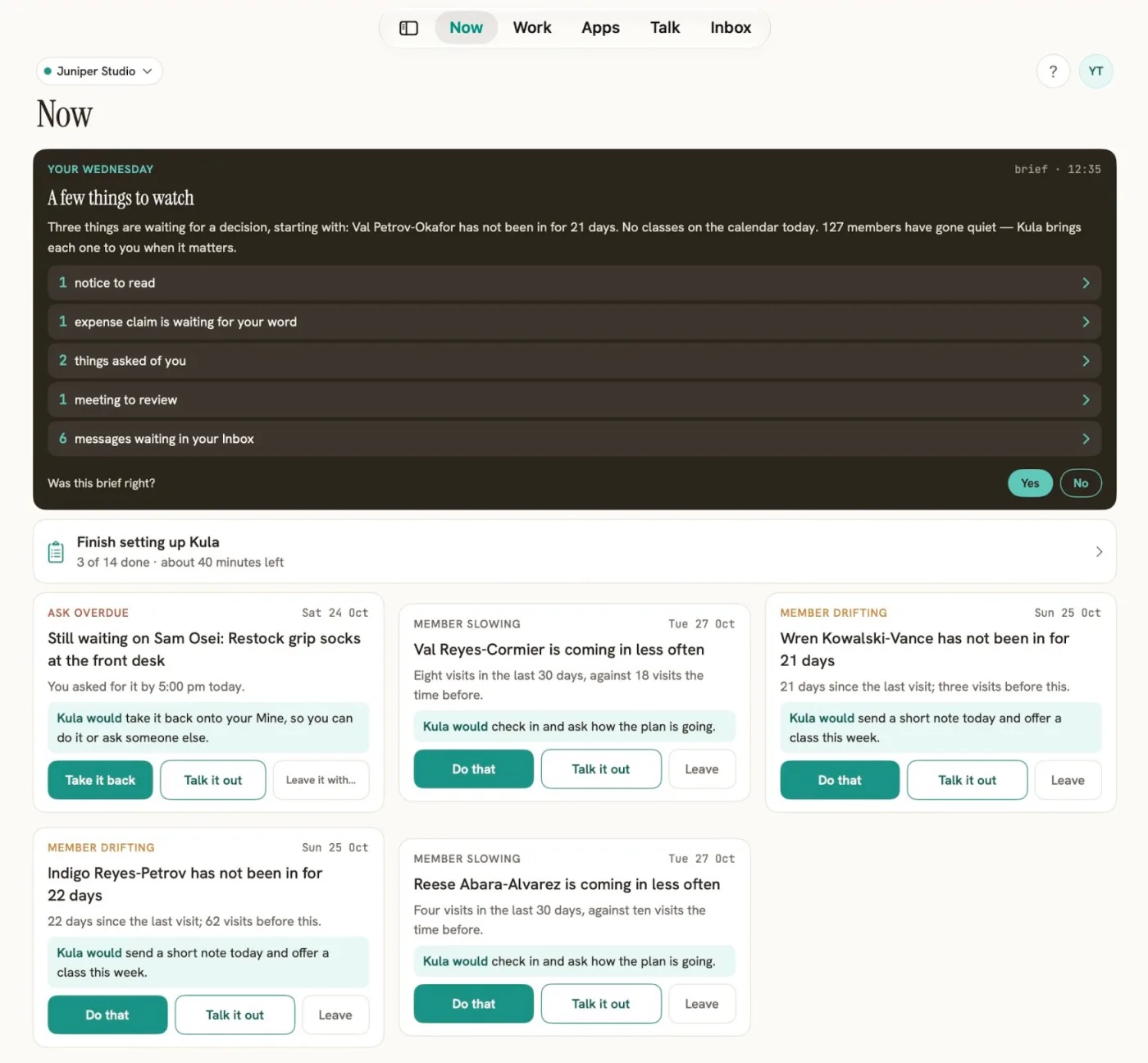
Kula Ops, on a demo business
Four moments from one day at a club. Kula Ops does the chasing, so the team can be with the people in front of them. The same scenes run in a clinic, a trades business or a build site.
Sam opens the club. A short brief is waiting: what needs a decision today, with a suggested next step on each, ready to act on or leave.
The person now knows what to do. Sam walks in knowing what to do first.
Illustrative shift, demo business
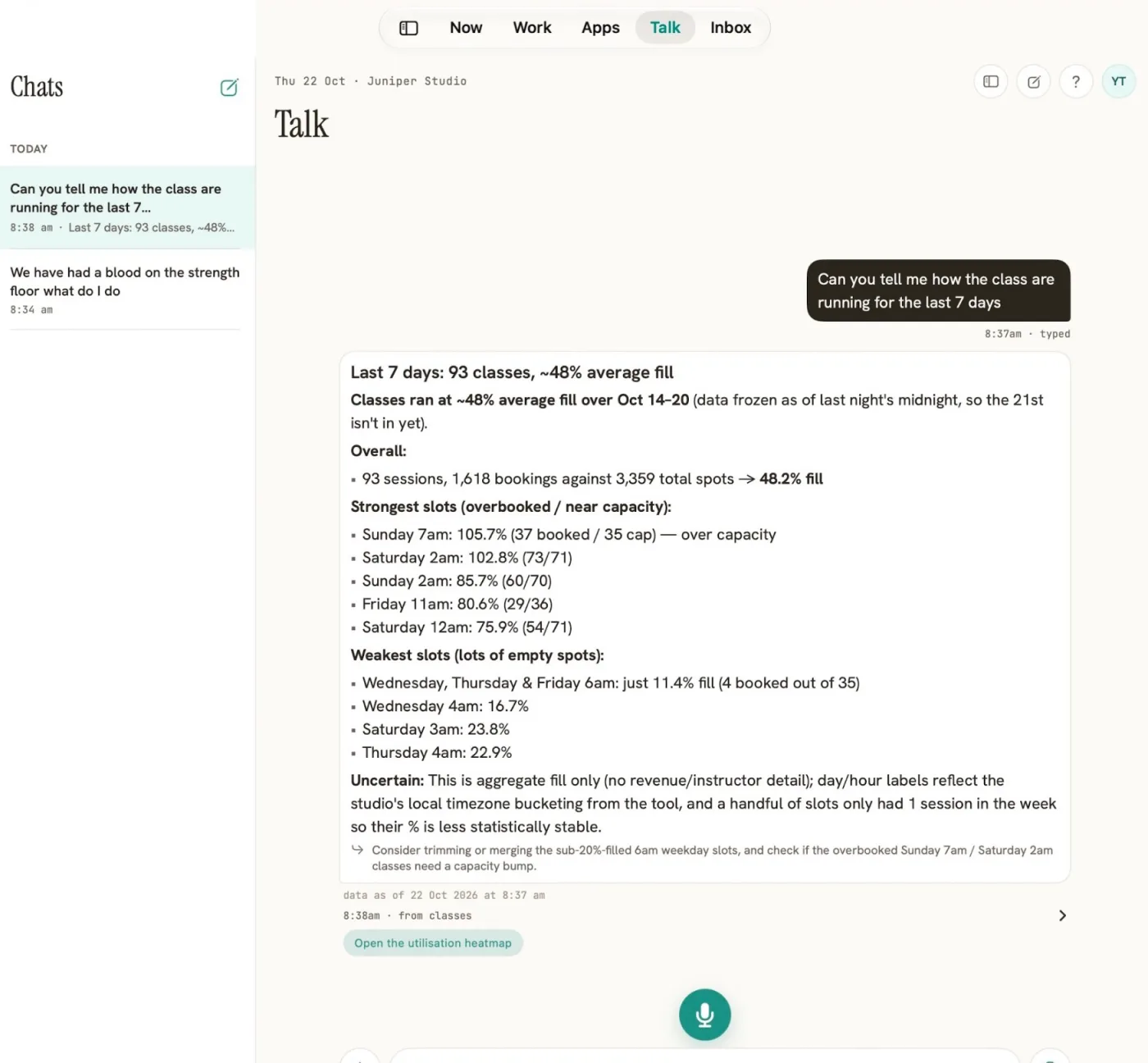
Mid-shift, Sam wants to know how the week is going. Asking in plain words returns an answer from the club’s own numbers, with the uncertain parts called out.
The person now knows what to do. No waiting for a report, and no guessing.
Illustrative shift, demo business
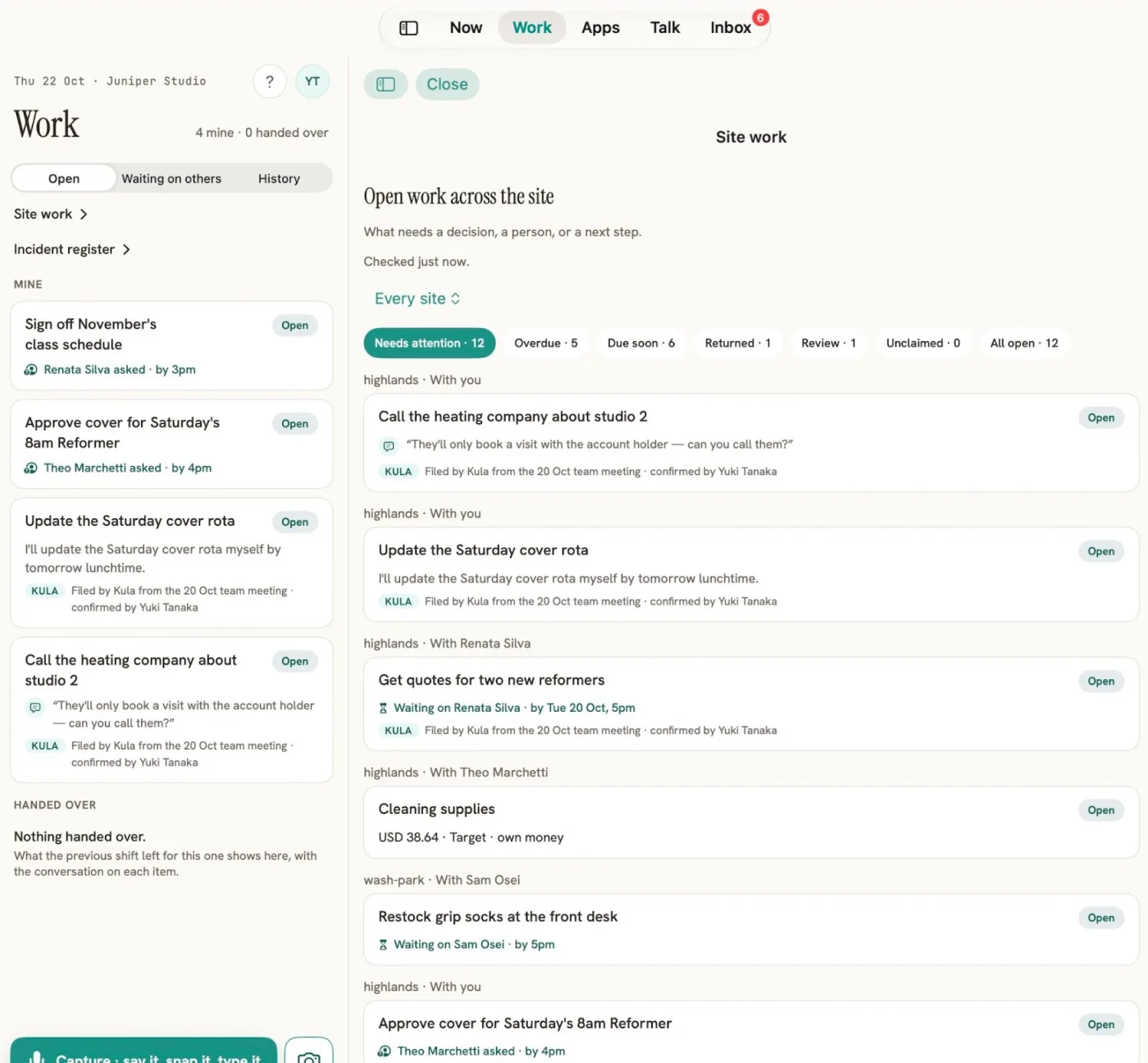
The Work screen shows every open job across the site: who each is with, what is overdue and what is coming due, including the to-dos filed from the team meeting.
The person now knows what to do. Sam knows who has what, and what needs a nudge.
Illustrative shift, demo business
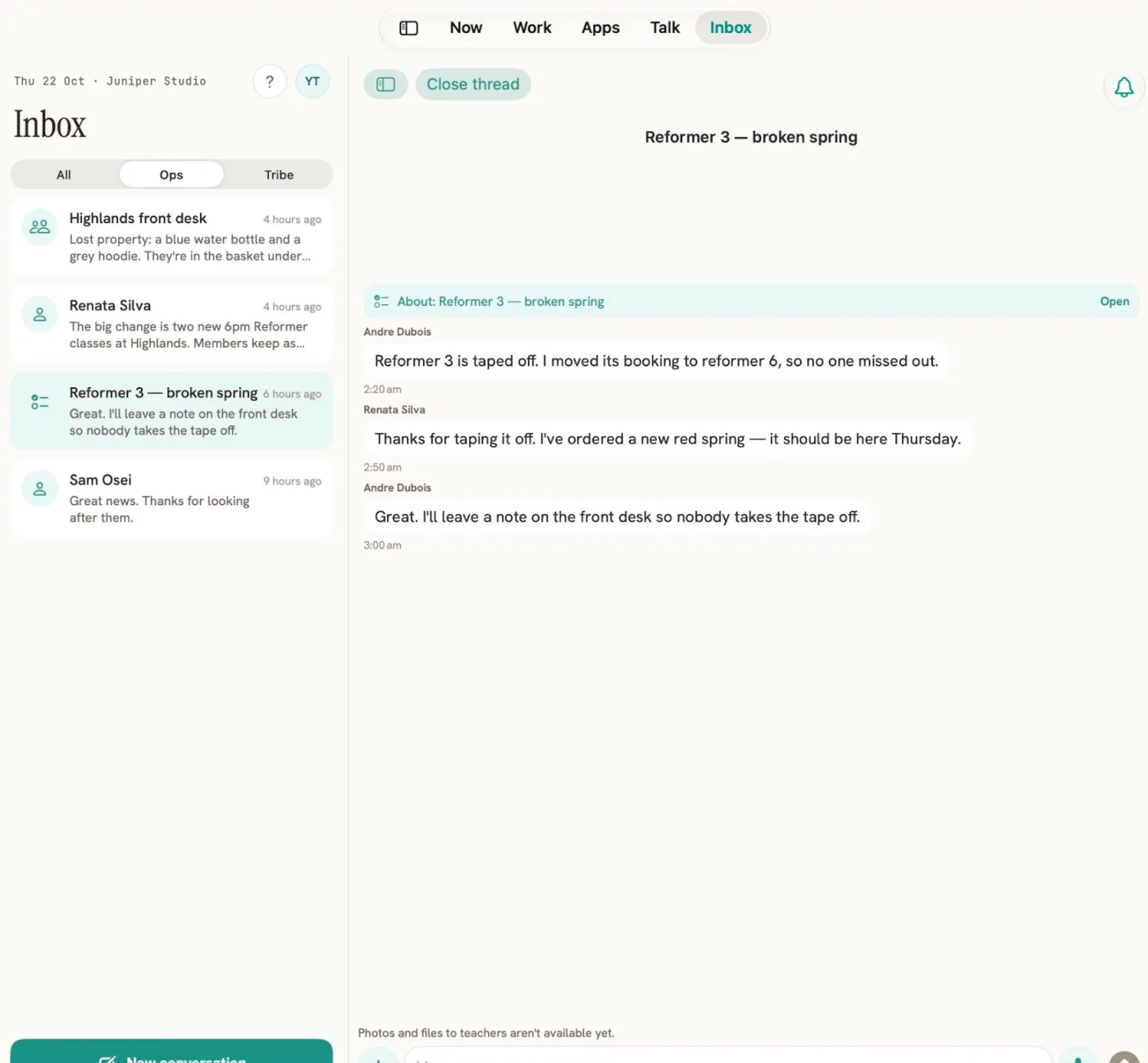
A reformer spring breaks. The team thread keeps the fault, the fix and the note for the front desk in one place, so the next shift knows to leave the tape on.
The person now knows what to do. The morning shift starts where tonight finished.
Illustrative shift, demo business
Your booking or job system, your roster tool and your accounts each do their part. What no system does is the work around them: the question at the desk, the follow-up on a lead, the broken machine, the handover to the next shift, the decision that waits for the owner. In a gym, a clinic, a trades business or a build site, that work is done on foot, by phone and from memory, and when someone leaves, the memory goes with them.
Kula builds a model of how your business works from the documents and systems you already have, and puts it in your team’s hands. They say what happened or ask on their phone, and Kula answers from what it knows about your business or does the task under your rules.
Nothing to rip out or replace. Kula starts with what you already have and works alongside the systems you already run.
Connect the systems you run and share the documents you have. Kula builds a model of how your business works, and keeps learning, week by week.
When you are ready, every person gets the right briefing, duties and help for their role, on an iPad, a desktop or a phone, and the asks, faults and follow-ups start getting done from there.
Agree a baseline, track the early wins, and add your own Apps. Add the industry edition, such as Kula Fitness with the Tribe app, when it suits.
A follow-up that takes a club manager 7.4 minutes takes 2.2 with Kula Ops.
Model estimateShow the workingHide the workingThe example: a club manager asks, “Has the 6am door fault been fixed?” They have to find out whether the contractor came, whether the desk logged it and whether members were told.
3 in 10 follow-ups still need the manager, and those take the same steps as today. The other 7 in 10 are handled and logged by Kula.
Walking over and messaging are each half of follow-ups, so the third step is the blend of the two.
Time back for members, the team and the floor. People run the clubs. Kula supports them.
Kula Intelligence connects to the systems you already run, keeps the model of your business current, and answers in plain language from your own numbers.
No sign up needed. Kula Intelligence also works from Claude, ChatGPT and other AI tools. About Kula Intelligence →
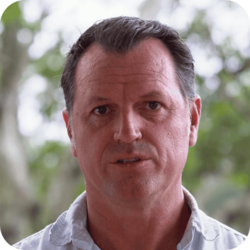
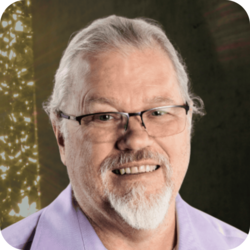
We come at this from two sides. One of us has spent 25 years running studios, and the other has been building software for small businesses since 1985.
The best businesses we have known were never run by software. They were run by people who knew every name, every routine and every quirk of the building.
Kula exists to give every team that kind of knowledge, without burning out the few people who carry it. People run the business. We just make sure they are never on their own.
Kula started in fitness, where Phil has spent 25 years. The same method now models other businesses where people deliver the service and the know-how lives in a few heads. The figures are modelled on published research and industry documents, and your own data replaces them once we model your business.

back to the team across five clubs. The biggest share is staff questions: about 460 a week, each a walk to find the manager today.
Modelled on industry research See the model →back across the build, and the last house handed over about six months sooner.
Modelled on industry research See the model →back across the production, and a shoot day that does not have to be added.
Modelled on industry research See the model →back to the team, so the business can take on more work without the next hires.
Modelled on industry research See the model →Break a task into steps, time each one, multiply by how often it happens, compare before and after. The method in plain words, worked through on a five-club gym, and why every figure is a model estimate until you measure it yourself.
Our creation and build story: how a team that started out paying yoga teachers ended up building for the people who run a business, and why every step along the way became part of Kula.

Tell us a little about your business and we will be in touch to find a time. Replies come from Phil or Peter.